Challenge
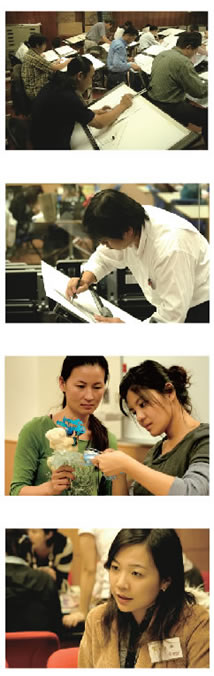
Professional studies
Professional Training and Certification Programs
Taiwan’s increasing emphasis in building a knowledge society has made lifelong learning becoming incrementally essential to knowledge workers of today and tomorrow. SCE’s Specialized Professional Divisions are specially crafted to devote full-time effort in designing programs and curricula that are up to date, practical and meeting up to the state-of-the-art needs and demands of the fast-changing society.
Variation and Wide Course Ranges
Every month, SCE provides a whole range of lifelong learning courses that are up to date enough to cover all sorts of variety in professional development programs, including international languages, management, finance, arts, health, languages management, teacher training programs, communication, computer software and hardware courses, music, multi-media, and so forth.
National and International Certification Programs
To meet growing demand professional certification programs at the national and international levels, across all areas, three sub-divisions have been established.
|
Out-house Training Programs
SCE’s professional services are not only rendered to in-house participants, but also out-house needs. These programs are specially designed based on the specific needs, criteria and conditions laid out by corporations, government institutions, as well as other non-profit organizations, who may be interested specially tailor-made courses and programs.
Degree and Credit-bearing Programs
A wide range of degree and credit-bearing courses and programs are also offered by SCE to full-time as well as part-time students seeking an undergraduate and graduate programs across all different fields.
Part-time Graduate Degree Programs
- Master of Arts in Chinese Literature
- Master of Arts in Journalism
- Master of Arts in Arts
- Master of Arts in Architecture and Urban Planning
- Master of Science in Applied Life Science
- Master of Science in Tourism and Leisure Business Management
- Master of Science in Youth and Child Welfare
- Masters in Business Administration, International Business Administration
- Masters in Business Administration, Information Management
- Master of Science in Political Science
- Master of Law
Part-time Undergraduate
Degree Programs
and two-year Completion Programs
- Bachelor of Arts in Business Administration
- Bachelor of Arts in Accounting
- Bachelor of Arts in Banking and Finance
- Bachelor of Arts in Information Management
- Bachelor of Arts in Advertising
Features
During the freshman year, students are admitted without a specified major. However, towards their sophomore year, they may begin to select majors according to their interests and needs. During these two years, special mechanisms have been injected into the system to provide systematic and consistent checking points to facilitate and enhance students’ learning experiences, including full-time counselors who have been specially trained to facilitate student learning and counsel students on their academic paths. These counselors are the main communicators for students’ relating to academic as well as non-academic issues, with aims to monitor, help as well as facilitate students’ learning progress and any problems directly or indirectly related to them. Such a mechanism provides so-called ‘Early Warning Signals’ to students encountering difficulties, providing them guidance and counseling before it is “simply too late”.
Quality Road Blocks
Quality road blocks have been set up prior to students’ graduation in order
to ensure that SCE that on top of professional skills and knowledge, graduating
students are also strongly equipped with technical as well as language skills
that are competitive enough in the market, and if not, more competitive than
that of graduates from other institutions.
In order to achieve this, two systems have been embedded into these quality
road blocks, including (a) a strong emphasis on computer-learning, as well
as (b) strong second language skills, upon graduation. As a result, all students
are required to go through a well-developed series of computer learning courses,
consisting eight thorough levels; and a ten level English program or r Japanese,
as another alternative choice, the former which is set up in accordance with
the State University of New York at Buffalo, which designs, implements, and
monitors intensive and Business-related English language programs, in the aims
to enhance graduating students’ international perspectives as well as language
capabilities.
In addition to the normal stream students’ ‘road blocks’, an Honors Program had also been established for students who achieve beyond the minimal requirement, with attractive incentives for them to pursue towards as well as continue to strive for excellence by providing tuition discounts and scholarships.
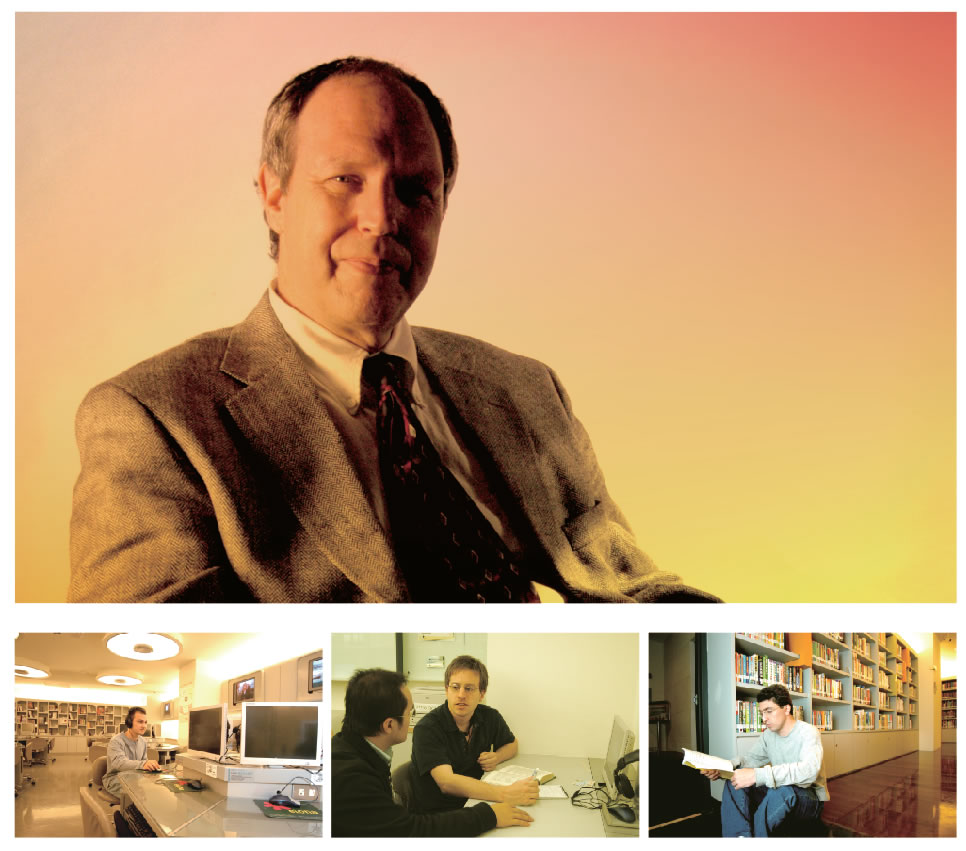
Dr. Peter Silver has been involved in English education for more than twenty five years and has a wide international perspective on teaching English in various international sites. He is a doctoral graduate of the University of Massachusetts, and his research interests are in bilingual education and language development programs for teachers.
University at Buffalo The State University of New York and Chinese Culture
University’s School of Continuing Education have created a partnership with
a high commitment to quality language development for local students in Taiwan
in the aims to equip students with strong communication skills, effective for
the corporate world of tomorrow.
The special features of the English partnership program comprise high aims
in using the ‘communicative’ approach in delivering content, as well as providing
content and contexts that are practical and realistic enough to meet the business
needs and demands of the corporate world.